Date: March 10th, 2010
Category: Class Projects

Illuminating Object

This gentle flashlight — designed to be used during midnight trips to the bathroom, fridge, or anywhere else that requires just a little bit of light — is the result of an exercise in brand development. It began with creating an onliness statement, a Mad-libs style way of encapsulating a brand:

The Wayfinder is

What: The only _____ (category)

The only home navigational lighting tool

How: That _____ (point of differentiation)

That brings ease, comfort, and pleasure to the middle of the night for people sharing their space who must navigate darkness while not disturbing others and enjoying the journey itself

Who: For _____ (market segmentation)

For people Sharing their space who must navigate darknesswhile not disturbing others and enjoying the journey itself

Where: In _____ (market geography)

In Suburban apartment complexes NYC 5th floor walk-ups and anywhere else space is a commodity

Why: _____ (focus on the need)

For those moments when a little light will do

When: _____ (the trend)

When there is a movement toward minimal consumption and simplicity

It is simple, active only when engaged  and designed to be sold at a retailer with great yet affordable design: Target

Thanks to my roommate who has two degrees in Electrical Engineering from MIT, I was able to  wire up a circuit that allowed the light to slowly turn on when you pick it up but instantly turns off when you set it back down on the special stand. There are some magnets, transistors, and a bit of magic that go into it.

Light Coming On

The Wayfinder fits comfortably in an adult hand, and is unobtrusive enough to live on a bedside table.

IlluminatingObject

Date: February 28th, 2010
Category: Typical Day
1 msg

Cars

This past week I had the privilege of going on a field trip with my Formgiving class to visit the car collection of my program’s most famous graduate. We spent over an hour hearing about his reason for purchasing each of the cars and his philosophy on how to maintain each vehicle; some he keeps in original condition, just as they would have been when they were new, others are modified and customizes to his own tastes.

The way he speaks about maintaining cars reminds me of  how conductors choose to lead their orchestras: some play the notes exactly as written on the page, others use the notes as suggestions and offer the audience an interpretation. He chooses whichever approach is most appropriate for a given vehicle. I was fascinated by the complexity of maintaining this fleet of classics.

Although I have never had much interest in cars for more than basic transportation needs, this visit helped me to appreciate them as an embodiment of the ideals of a given era, and a medium for design expression. These old cars had so much character compared with the cars of today – the colors, the grills, the shapes. I’d be happy to tool around in any of them, enjoying the satisfying roar of their motors all the way.

Yellow Car

Chevy was so much better back in 1951.

IMG_4085

This hood ornament looks like she’s going to take off!

Date: February 16th, 2010
Category: Class Projects
Comments Off

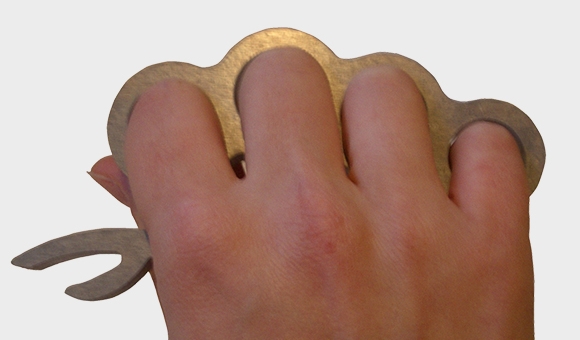
A Pen in the Style of…

Movado. Best known for their watches with the striking black faces, they also produce stunning jewelry in the same strongly geometric style.

IMG_0770

Material: Aluminum
Processes: Mill, Lathe, Polishing, Anodizing

Elsa Peretti, who’s held a special place in my heart since receiving a piece of hers as a high school graduation gift. The only appropriate way to present a jewelry-like piece is in the official Tiffany & Co.blue trimmings.

Tiffany_packaging

Elsa_paretti_real_hand

PenCloseup

Material: Sterling Silver
Process: Lost Wax Investment Casting

Unfortunately, Tiffany & Co. is protective of their wrappings; the only way to get the bag, box, ribbon, etc. was to actually buy an Elsa Peretti pen. I thought mine came out much nicer than hers.

Date: February 6th, 2010
Category: Class Projects

Needfinding

My program is turning me into a stalker. I have spent countless hours observing people in public spaces — airports, movie theaters, Home Depot — in order to tease out interesting behaviors phrased into “nuggets” like “the Stanford Theater’s comfortable environment means that more people go alone to this theater than a typical first-run” and “waiting to buy coffee in a line that is too constrained makes people feel uncomfortable.” While these nuggets are not terribly profound, they are the first step in a process called “needfinding.”

This process of needfinding is at the heart of Stanford’s human-centered approach to design. The idea is that in order to design products that work for people and fit into their lives, you first need to observe them to determine what they actually need. This process is not as simple as asking someone: “So, what can I design to make your life better?” If people were able to consistently tell you what they needed, the process of ethnography – a term adopted from anthropology, meaning an in-depth interview, observation of, and even participation in a person’s life – would be much easier.

It turns out that many needs in a person’s life are invisible to them. We develop “work-arounds”, like shoving a sugar packet under the leg of a table, or assume the problem lies with us as the user, like the doors you have likely had trouble opening because it wasn’t clear if you were supposed to push or pull. These are simple examples, but the same types of behaviors play out every day for all of us, meaning that in order to truly see what we need, it often takes the fresh eyes of an outside observer.

Right now I’m in the midst of a project called “Moccasins,” in honor of the proverb “in order to understand someone, you must walk a mile in their moccasins.” My partner and I have had a great time riding along with two of the finest drivers at Ellison’s Towing, the local contractor for all of the AAA calls around Stanford. I can’t say enough good things about how friendly and accommodating each and every person there was – from the wonderful receptionist who organized it, to the drivers who let us ask them questions until we were blue in the face.

We have been impressed at the demands of their job — when was the last time you tried to drive on the freeway or back up while towing an SUV? — and the high level of expertise — being able to diagnose a problem from the sound a car makes, and knowing exactly which tools you need and which of the couple dozen car batteries in your arsenal is the one they need installed. It is only when a person is stranded on the highway, has a dead battery when they need to make it to work, or needs their car opened to retrieve the toddler who locked herself in along with the keys that they recognize the heroic nature of this profession.

The drivers treat cars with utmost care, placing a piece of paper under  a caution light to prevent damage.

The drivers treat cars with utmost care, placing a piece of paper under  a caution light to prevent damage.

We also noticed that a sense of vulnerability gets in the way of this heroism; the work is dangerous (one driver informed us that 20 times as many tow truck drivers die each year as California Highway Patrol officers) and when a driver arrives, they alone are responsible for solving the problem and satisfying the customer. This is true even if the problem involves cutting down a few trees in order to pull a car out of a ravine (as one driver described doing). There is no back-up when you’re out in the field like that.

Surprisingly, the tools supplied to the drivers interfere with their ability to serve customers. One driver had problems with his gloves — waterproof ones make his hands sweat, bulky ones get in the way, thin ones don’t keep his hands dry in the rain, etc. Another driver explained that oftentimes he will have the battery a car needs, but not the right wrenches, screwdrivers, etc. needed to change it, a problem that has happened enough that he’s resorted to supplementing the company-supplied stock with tools of his own.

Tool Box

Tools are an important part of the job. Each driver maintains their own set. The driver I rode with purchases many of his own in order to be prepared for the newest and rarest cars he encounters.

The process of needfinding is not just identifying “tow truck drivers need better gloves…”; it’s about identifying an entire network of needs “… because they need to be a hero to customers by focusing on solving their car trouble and staying safe along the side of a busy highway.” It is only through this type of in-depth observation that designers can construct this web of needs and design products that make people’s lives better, rather than gadgets you might find in the SkyMall catalog.

Date: January 31st, 2010
Category: Class Projects

Expressing Emotion with Foam

Formgiving is the closest thing to an Industrial Design course that JPD students take. The class is focused on using an object’s form to convey meaning and style, and the scope of the class is limited to four major projects, compared with more than a dozen in last quarter’s art class. This focus allows students to achieve a higher level of refinement in their finished work.

Last week I completed ‘Opposites,’ a set of four objects carved out of pink foam — a material you may be familiar with if you’ve ever had to insulate a house.

I first rendered a set of three pairs of forms:

Open and Closed
Utilitarian and Decorative
Sensual and Sterile

From these, I pared the list down to the final two, made some tweaks, and created the 3D forms with the help of Adobe Illustrator, a bandsaw, an Olfa knife, sandpaper and a sturdy respirator.

Utilitarian and Decorative

In utilitarian and decorative, I took the same basic shape, and used the slices to make one form very literally the decorative version of the other. There is a beauty inherent in simplicity, and that shows through in this pair; the decorative one, while it may be the first to catch one’s attention, is not the one that I find as satisfying as the reserved utilitarian form.

Sterile and Sensual

Sensual and sterile was the more successful of my pairs. I am particularly pleased with how the sensual form came out. I loved the process of taking a solid block of material and slowly carving it down, letting the sensual shape emerge. I hope to use this process in my next project: two pens in the style of my favorite designers.

Sensual

Date: January 12th, 2010
Category: Class Projects

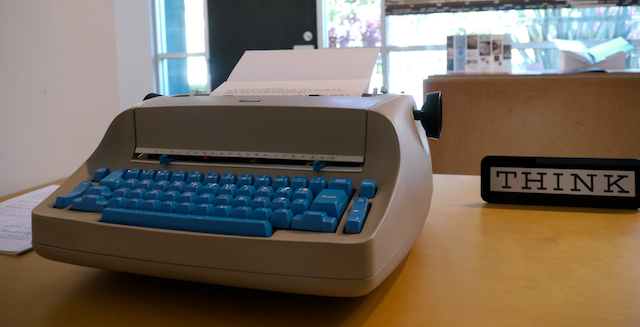
Eames and IBM

This quarter I am working with fellow student Michael Turri on an independent study to research, document and organize historical information on projects the famous Eames Design Office did for IBM. This research will become the basis for a class Michael and I will teach next year on exhibit design, with the goal of installing this exhibit in a local museum.

The name Eames is usually associated with famous furniture like the bent plywood lounge chair, but the Office worked on countless other projects, from famous videos like Powers of Ten and toys like House of Cards to relatively unknown exhibits. I even read that Charles Eames consulted for MIT, giving recommendations on how they could better integrate arts into their technical curriculum.

For this project, Michael and I are focusing on the many decades worth of work the Eames Office did for  IBM. This relationship began with the famous 1961 Mathematica Exhibit the Office designed for the California Museum of Science and Industry and lasted until Ray died in the 1988. A couple of these exhibits still exist — I was able to enjoy the one in Boston’s Museum of Science back when I was an undergrad in Cambridge, having no idea of its historical importance at the time.

Mike Turri photographing documents

This past week, Michael and I visited John and Marilyn Neuhart, some of the last surviving members of the Eames Office. It was incredible to hear their recollections of working on projects for IBM, as well as just chat about how field of design has changed over the years. The Neuharts are cleaning out their office, an unassuming cinder block building crammed full of meticulously-cataloged materials spanning decades of work. John and Marilyn spent three years in talks with Stanford’s Special Collections, but in the end the deal to sell their collection to our library fell through, and the materials are on their way to an auction house in Chicago — much to our dismay. We made it to their office just in time to photograph as much of the two book shelves of IBM-related materials as we could.

So far I’m having a blast with this independent study. I can’t wait to see what lies ahead.

Date: December 28th, 2009
Category: Typical Day

Holiday Traditions

Every family has their quirky holiday traditions. My personal favorites happen to be edible. In my parents’ house, where I am spending the holidays, food is meant to be played with. We in the Martini-Goldstein family don’t take ourselves too seriously, which leads to some pretty interesting culinary combinations (think lime JELL-O served with coffee ice cream for Christmas dessert, and crab aspic as a Thanksgiving side dish).

A few years ago I began a new holiday tradition: over-the-top JELL-O molds. What originally began as a joke for some rather refined dinner guests has become on essential element of our secular Christmas celebration. This year’s version was a simplified version of what I have made in the past, consisting of only three colors of JELL-O and two types of fruit. I have to admit that I have become embarrassingly good at these JELL-O creations.

jello

This is the dish in process. I assure you that many technical skills are required to pull off JELL-O like this.

Martini cutting the Jello

The pièce de résistance. Don’t be fooled by how it looks; it’s actually quite good.

Even better than going crazy with JELL-O is decorating gingerbread cookies. There are dozens of cookie shapes to choose from (for reference, the large plastic bin in the background of the photo above is used to store cookie cutters), as well as the ever-popular option of making random shapes with the dough.

The decorating process is pretty impressive. Below is a picture of one of the many muffin tins we filled with sprinkles and candies, which belies the fact that I come from a family of systematic perfectionists (if the organization system doesn’t convince you, perhaps the fact that many of those toppings are applied with tweezers will). In addition to a couple dozen types of toppings, we fill our large collection of frosting guns with hues from many often-overlooked corners of the color spectrum — including some of the neon variety. We are nothing if not thorough.

Cookie topping assortment

Sadly, our gingerbread cookies have a very short half-life, likely due to the strict family policy of eating any cookie with a defect (a standard loosely interpreted to mean it has more value when eaten than looked at). Of the handful to survive, the two below are my personal favorites.

Unicorn Cookie

Monkey Cookie

Date: December 6th, 2009
Category: Typical Day

Personal Statements Personal Statements

Last night was the annual Personal Statements events, for which each of the 13 second-year students spent the past two weeks creating an exhibition that embodied some important element of themselves. I have chosen to share  a few of my favorites from the evening (mainly because they were the ones I had a chance to photograph) but you can find a more comprehensive collection here, courtesy of second year David Goligorski.

I found Matthew Freshman’s display of deconstructed instruments to be both visually compelling and disturbing. To me, instruments are to be cared for and protected, not sawed apart and strung up, disembodied.

IMG_3343

Who doesn’t love fire? John Stanfield’s flaming tube was an impressive way to visualize the music coming out of the keyboard. It reminds me of the Rubens’ Tube I made with my physics teacher in high school, but bigger and scarier.

IMG_3351

I absolutely love Danika Patrick’s flower beds. I thought this this project had the strongest element of design (as opposed to art or engineering) of the evening. It’s too bad that her beautiful piece can’t stay out in our courtyard permanently.

IMG_3347

Date: December 3rd, 2009
Category: Class Projects
2 msgs

Changing Behavior with Pirates

The final project in Human Values and Innovation in Design was to design a system leveraging smart phones to promote healthy behaviors. I was thrilled to have a chance to work Anisha Jain, a fellow first-year student who I discovered is particularly skilled at conducting interviews – a major component of the Stanford design process. After four weeks of hard work, we came up with a pirate-themed treasure hunt for kids who are grocery shopping with their parents. The treasure hunt provides a list of ingredients, which can then be used to make a healthy snack. For example, celery, peanut butter and raisins become “Celery Vessels with Raisins” in the pirate-themed application (more commonly known as ants on a log). When the child returns home, they may access recipe information on a website containing nutritional information targeted at children. Check out the demo video for more details.

Treasure Hunt at the Grocery Store from Laura Martini on Vimeo.

We had initially chosen to focus on preventing type II diabetes, and interviewed people who considered themselves at risk for the disease — meaning they had a family history of it, had been told by a doctor they were at risk, etc. — hoping to gain insights into how people modify their behavior when faced with a major incentive like preventing diabetes. We were shocked to discover a lot of apathy; even when people know they’re at risk, they do very little to prevent the disease’s onset.

After prototyping a number of iPhone apps – some as simple as a way to set a daily food or exercise goal, some as complicated as a system financial rewards for purchasing a lot of produce and other healthy foods at the grocery store – and testing them out on a variety of users, we discovered that adults weren’t that excited about any of them for various reasons including “it’s awkward to use a phone while holding a shopping list and pushing a cart,” their eating behaviors are too ingrained, and “I’m too busy for something like that.”

While observing harried dinnertime shoppers at our local Safeway, after hearing “I’ve eaten this way since I was a kid” for the Nth time, and observing a number of bored children being shepherded around the store, we had an epiphany: we realized that kids are the perfect user for a grocery store app. We take advantage of the fact that children have plenty of time while their parents are grocery shopping, and use the opportunity to engage them in the shopping process. We empower them to navigate the store themselves, and learn which sections have healthy food.

Treasure Hunt Booty

We stopped by a Whole Foods last night to get feedback on our final concept and got a very enthusiastic “I want to go on a treasure hunt!” from an adorable 8-year-old. What better evidence do you need?

Date: November 28th, 2009
Category: Typical Day
1 msg

Cartoon Art Museum

While recovering from my turkey-and-pecan-pie-induced-coma this afternoon, I visited San Francisco’s Cartoon Art Museum. The venue is very small– just the right size for a perfectly digestible bit of culture.

My favorite exhibit was Once Upon a Dream: The Art of Sleeping Beauty. Not having seen the film since I was a kid, I had no appreciation of how great this film was from an artistic perspective; artistic lead Eyvind Earle was given free reign and nearly ten years by Disney himself in order to create the film’s “unique blend of lush detail and bold, stylized designs.” The best part was seeing the rough sketches, and Sleeping Beauty painted with many trial combinations of skin and dress colors juxtaposed to the final animation cels. In the Stanford JPD we place a lot of emphasis on these types of simple sketches and cardboard mockups, knowing this process can (and often does) yield wonderful masterpieces.

Other current exhibits include Monsters of Webcomics, where the medium meets the internet, Fantastic Mr. Fox’s puppets and sets, and Spain Rodriguez: Rebel in Ink and the highlights of his 40-year comic book career.

Unfortunately, cameras weren’t allowed inside the exhibit, so you will need to go in-person to enjoy the shows.
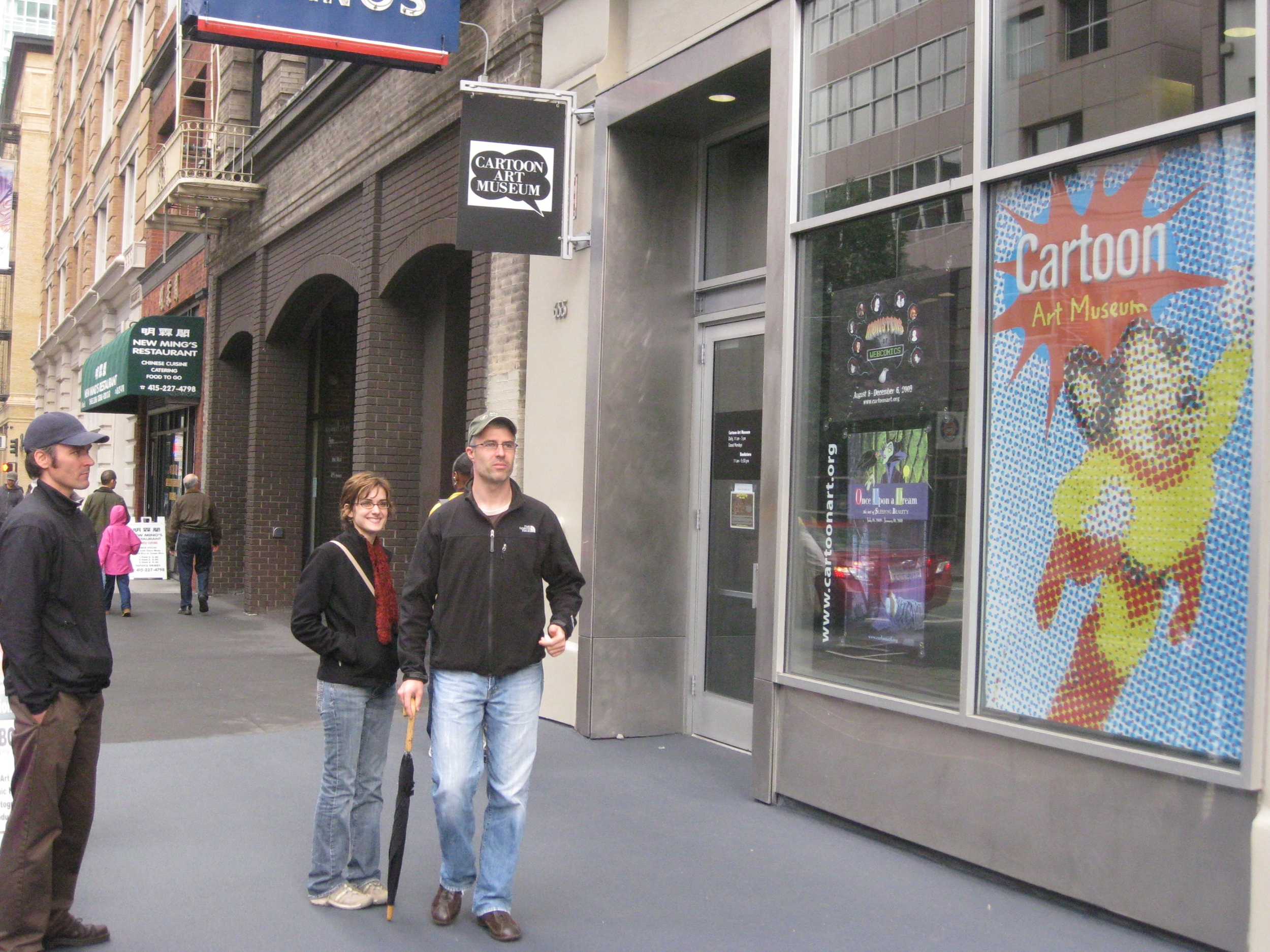
IMG_3325